Choosing the right Single Phase Motor in 2026 requires more than comparing price, horsepower, and delivery time. Global buyers must match motor design with real operating conditions. A small shaded-pole motor may quietly drive a ventilation fan. A capacitor-start motor may deliver the stronger torque needed by a workshop pump. These differences become obvious when equipment starts under load.
Electrical engineer and motor author Austin Hughes describes the core purpose clearly: “An electric motor is a device that converts electrical energy into mechanical energy.” The statement is accurate, but not complete enough for purchasing decisions. Buyers must also examine voltage, frequency, starting current, duty cycle, enclosure, bearing quality, and maintenance access. A 230-volt motor rated for 50 Hz may not perform correctly on a 60 Hz supply. That detail is easy to miss.
This guide reviews the leading Single Phase Motor types for international applications, including split-phase, capacitor-start, permanent-split-capacitor, capacitor-start capacitor-run, and shaded-pole designs. Each section connects motor structure with practical use. Expect examples from pumps, fans, compressors, conveyors, and household equipment. Performance labels can still mislead. A motor with impressive efficiency may struggle in dusty surroundings or frequent-stop service. A cheaper model may become expensive after repeated capacitor failures.
Reliable selection also depends on supplier documentation, tested performance data, traceable components, and recognized certification. Yet no checklist removes every risk. Site conditions vary. Buyer assumptions can be wrong. Careful comparison remains essential.
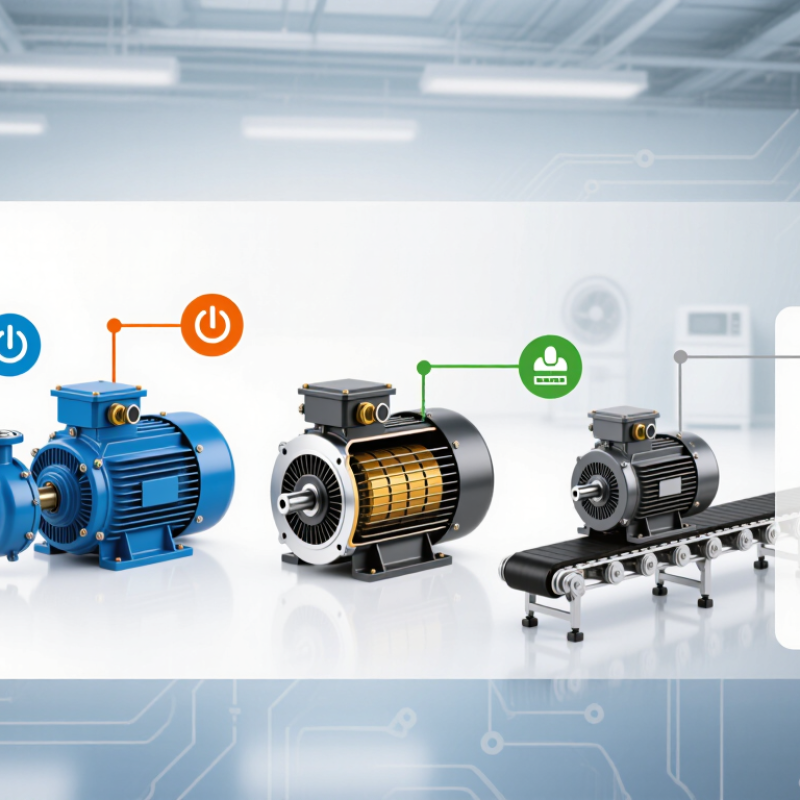
2026 Top Single Phase Motor Types for Global Buyers
Single-Phase Motor Basics and Selection Criteria for Global Buyers
Single-phase motors suit pumps, fans, compressors, conveyors, and small machinery. Common types include shaded-pole, split-phase, capacitor-start, and permanent split capacitor motors. Shaded-pole designs are compact and affordable, but their starting torque remains limited. Capacitor-start motors deliver stronger starting force for compressors and loaded equipment. Permanent split capacitor motors run smoothly in fans and blowers. Their efficiency may be acceptable, but not always impressive.
Global buyers should verify voltage, frequency, rated power, speed, duty cycle, and starting current. A 230-volt motor may not match every regional supply. Check the nameplate carefully. Enclosure protection matters in dusty workshops or humid pump rooms. Ask for insulation class, thermal protection, bearing details, and applicable safety documentation. Mounting dimensions also deserve attention; a small mismatch can delay installation.
Tips: Match starting torque with the real load, not an ideal test load. Confirm whether the motor runs continuously or intermittently. Compare efficiency at the expected operating point. A larger motor is not automatically safer. It may waste energy and create poor control. I would also request test data, because catalog ratings can hide operating assumptions. Selection is rarely perfect on paper. Recheck local standards, service access, and replacement availability before ordering.
| Motor Type | Operating Principle | Typical Starting Torque | Typical Output Range | Typical Speed Characteristics | Relative Efficiency | Common Applications | Main Advantages | Key Limitations | Important Selection Criteria |
|---|---|---|---|---|---|---|---|---|---|
| Split-Phase Induction Motor | Uses separate main and auxiliary windings with different electrical resistance-to-reactance characteristics to create starting torque. A centrifugal switch or electronic device usually disconnects the auxiliary winding after acceleration. | Moderate | Approximately 0.06–1.5 kW | Fixed-speed operation; commonly designed for 2- or 4-pole synchronous speeds with normal slip under load. | Moderate | Small fans, blowers, machine tools, office equipment, and light-duty appliances. | Simple construction, relatively low cost, and suitable for applications that do not require high starting torque. | Lower starting torque and higher starting current than capacitor-start designs; auxiliary switching components can require maintenance. | Check load inertia, required starting torque, duty cycle, supply voltage, frequency, and the reliability of the starting switch. |
| Capacitor-Start Induction-Run Motor | Uses a starting capacitor in series with the auxiliary winding to create a stronger phase shift during startup. The capacitor and auxiliary winding are normally disconnected after acceleration. | High | Approximately 0.12–3.7 kW | Nearly constant speed with normal induction-motor slip; commonly supplied in 2-, 4-, or 6-pole configurations. | Moderate to good | Pumps, compressors, conveyors, air-handling equipment, woodworking machines, and other loads that are difficult to start. | High starting torque and good general-purpose performance. | Requires a starting capacitor and switching device; repeated starts may increase component stress. | Match the starting-torque requirement, allowable starts per hour, capacitor rating, switching method, enclosure, and thermal protection. |
| Permanent-Split Capacitor (PSC) Motor | Uses a permanently connected run capacitor with the auxiliary winding. There is no centrifugal starting switch in the basic design. | Low to moderate | Approximately 0.03–1.5 kW | Efficient, quiet, and stable operation at a single rated speed; speed decreases as load increases. | Good at suitable load points | Ventilation fans, evaporator fans, blowers, air curtains, pumps, and small HVAC equipment. | Quiet operation, simple construction, reliable starting circuit, and good speed regulation for fan-type loads. | Starting torque is generally insufficient for high-inertia or high-breakaway loads. | Verify fan or pump load characteristics, capacitor value, airflow or pressure requirement, noise level, and continuous-duty temperature rise. |
| Capacitor-Start, Capacitor-Run Motor | Uses a large starting capacitor for startup and a separate run capacitor that remains connected during operation. A switching device removes the starting capacitor after acceleration. | High to very high | Approximately 0.25–7.5 kW | Good speed regulation under load and strong performance across a broad operating range. | Good to high | High-performance pumps, compressors, conveyors, refrigeration equipment, and machine tools. | Combines strong starting torque with improved running power factor, efficiency, and quieter operation than many basic designs. | More components, higher cost, and greater control complexity than simpler single-phase motors. | Evaluate starting frequency, locked-rotor current, run-capacitor rating, power factor, overload protection, and available enclosure options. |
| Shaded-Pole Motor | A copper shading ring delays magnetic flux in part of each pole, producing a weak rotating magnetic field and self-starting action. | Very low | Approximately 1–200 W | Low-power, fixed-speed operation; relatively high slip and limited speed regulation. | Low | Small fans, appliance timers, air circulators, display equipment, and low-power actuators. | Very simple, compact, inexpensive, and highly reliable because it has no starting switch or capacitor. | Low efficiency, low starting torque, limited output, and greater heat generation relative to useful power. | Use only for low-power loads with low starting torque; check thermal limits, noise, airflow, duty cycle, and energy-consumption requirements. |
| Universal Motor | A series-wound commutator motor designed to operate on either AC or DC. The armature and field current reverse together, maintaining torque direction. | High | Approximately 50 W–2 kW | Very high speed, often several thousand revolutions per minute; speed changes significantly with load. | Moderate; typically lower than efficient induction motors at continuous-duty operating points | Portable power tools, vacuum cleaners, kitchen appliances, and other intermittent-duty equipment. | High power-to-weight ratio, high starting torque, and compatibility with AC or DC supplies. | Brush and commutator wear, acoustic noise, electrical interference, and limited suitability for quiet continuous-duty applications. | Confirm supply type, required speed, brush life, electromagnetic compatibility, cooling, duty cycle, and maintenance access. |
| Single-Phase Reluctance Motor | Uses a salient-pole stator and a rotor that aligns with the rotating magnetic field; auxiliary starting arrangements are commonly used because the basic motor is not inherently self-starting. | Low to moderate, depending on the starting method | Typically below 1 kW | Runs near synchronous speed after synchronization, with small speed variation under normal load. | Moderate | Timing devices, instruments, small control mechanisms, and applications requiring nearly constant speed. | Nearly constant operating speed and relatively simple rotor construction. | Limited starting torque, lower power range, and less common than capacitor-based induction motors. | Check synchronization behavior, load torque, starting arrangement, allowable speed deviation, and suitability for the required frequency. |
| Hysteresis Motor | Uses the hysteresis properties of a magnetically hard rotor to produce synchronous torque after startup, generally with an auxiliary starting mechanism or special design. | Low | Typically below 200 W | Runs at synchronous speed with very low speed variation under rated conditions. | Moderate | Clocks, timers, recording instruments, and precision low-power drives. | Quiet operation, smooth torque, and excellent constant-speed performance. | Low output capability, relatively specialized construction, and limited suitability for high starting loads. | Prioritize speed accuracy, noise, synchronization requirements, allowable load torque, and continuous operating temperature. |
It suits ventilation fans, circulation pumps, air handlers, and light-duty compressors. The capacitor stays connected during operation. This supports steady torque and quiet running. Starting torque remains limited.
Yes, many are designed for continuous-duty operation. Check the rated duty, ambient temperature, insulation class, and cooling conditions. A motor running at 40°C needs suitable thermal margins. Heat changes everything.
Confirm voltage, frequency, speed, shaft size, capacitor quality, and expected starts per hour. Also review efficiency curves and continuous-duty limits. Catalog values may not match the finished machine. That happens.
They work well in compact, low-power equipment. Typical uses include ventilation fans, air curtains, display coolers, and light appliances. Their copper shading ring creates starting torque without a capacitor. The design is simple.
Starting torque is modest, and efficiency is often below 40%. They may struggle with heavy loads or frequent starts. Warm enclosures can increase operating problems. Low price is not the whole cost.
Capacitor-start motors provide stronger starting performance. They suit compressors, conveyors, and workshop equipment. Permanent split capacitor motors usually offer quieter, steadier operation. Neither choice is automatically better.
No. Load profile, annual operating hours, and correct sizing matter greatly. A lightly loaded efficient motor may waste more energy than a properly sized standard motor. The comparison is not perfectly clean.
Misaligned shafts, blocked airflow, unstable voltage, and undersized capacitors can increase heat and noise. Dusty pump rooms need different priorities from quiet indoor fans. Check mounting holes and shaft tolerances carefully. Small details matter.
This guide to the 2026 Single Phase Motor market helps global buyers understand the main motor types and choose the right solution for specific operating conditions. It begins with essential selection criteria, including voltage compatibility, starting torque, duty cycle, efficiency, noise, maintenance needs, installation space, and total operating cost. These factors are important for matching motor performance with regional electrical systems and equipment requirements.
The guide compares capacitor-start motors, which provide strong starting torque for demanding loads, with permanent split capacitor motors designed for smooth, continuous-duty operation. It also explains shaded-pole motors, a compact and economical option for low-power equipment with modest starting demands. By evaluating efficiency, purchase cost, reliability, control requirements, and application suitability, buyers can make a practical comparison and select a motor type that balances performance, service life, and budget for their intended equipment.

 Luv Motors