In 2026, global buyers will evaluate Torque Motor types by precision, thermal stability, efficiency, and total ownership cost. Direct-drive torque motors are gaining attention because they remove gearboxes, backlash, and several mechanical wear points. They fit robotic joints, semiconductor stages, medical scanners, machine tools, and precision rotary tables.
The International Energy Agency reports that electric motor systems consume roughly half of global electricity. That figure makes efficiency more than a technical preference. It becomes a purchasing responsibility. The U.S. Department of Energy also identifies motor-driven equipment as a major industrial electricity consumer. These findings support closer comparisons between frameless torque motors, housed rotary torque motors, pancake designs, and water-cooled high-torque models.
The right type depends on the application.
A frameless motor can save space inside a robotic joint, but it demands careful bearing and encoder integration. A housed torque motor simplifies installation, although its package may restrict machine design. Pancake motors offer short axial length, while water-cooled models can sustain higher continuous torque in compact equipment. Suppliers increasingly publish thermal curves, torque-speed maps, encoder compatibility, and overload data. Buyers should request those details before comparing catalog torque values.
Industry forecasts from MarketsandMarkets and Grand View Research continue to show strong growth across electric motor and industrial automation markets. However, broad market numbers do not guarantee a suitable Torque Motor for every machine. Reported growth can hide differences in duty cycle, cooling method, supply voltage, and service support. That is where this guide remains deliberately practical: specifications matter, but field experience often exposes the missing detail.
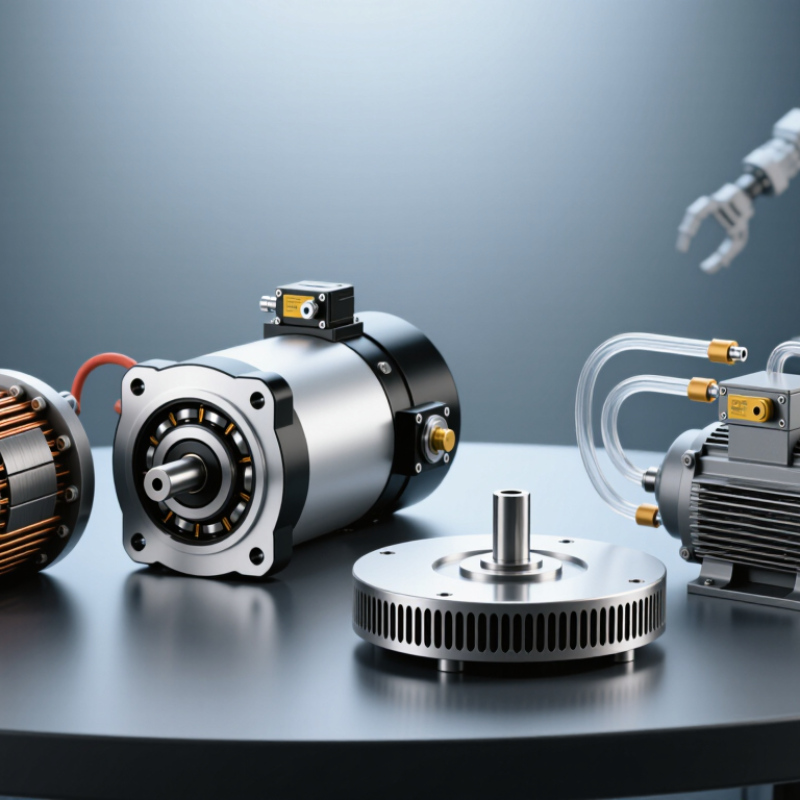
Torque motors are permanent-magnet synchronous motors built for high torque at low speed. They often remove gearboxes from rotary equipment.
Common designs include frameless kits, housed motors, and pancake-shaped units. Frameless motors require the machine builder to provide bearings, housing, and position feedback. Housed motors arrive as integrated assemblies. That difference affects installation time, alignment, and maintenance.
Start with continuous torque, not the attractive peak value. Continuous torque describes the output the motor can sustain without exceeding its thermal limit. Peak torque usually lasts only seconds.
Torque constant, measured in newton-metres per ampere, links current to output torque. A higher value can reduce current demand.
Back electromotive force limits speed as rotation increases. Check the bus voltage carefully. It can change the usable speed range.
Thermal resistance shows how easily heat leaves the windings. Cooling may use natural convection, forced air, or liquid channels. Duty cycle matters.
A motor moving a 20-kilogram rotary table every few seconds needs different sizing than one turning continuously.
Cogging torque can create small speed ripples, especially at low speed. Feedback resolution also matters for smooth positioning.
Bench tests often reveal unexpected heating near mounting surfaces. That detail is easy to miss.
Selection is not perfect. Real loads, wiring losses, and imperfect alignment can change the result. Reliable buyers compare measured curves, protection ratings, tolerances, and service conditions before approving a design.
Core torque motor types available to global buyers in 2026 include frameless, housed, iron-core, and ironless designs. Frameless kits place the rotor and stator inside the machine, saving space around rotary tables or robotic joints. Housed motors arrive as integrated units with bearings, encoders, and protective covers. They reduce assembly risk. Iron-core motors provide high continuous torque, while ironless motors offer lower cogging and smoother motion. The boundary is not always clean.
Market demand supports this wider selection. The International Federation of Robotics reported 541,302 industrial robots installed worldwide in 2023. That volume increases demand for compact, responsive rotary actuators.
Grand View Research estimated the global electric motor market at about USD 143 billion in 2023, with continued growth through 2030. These figures cover more than torque motors, but they show the scale of the equipment ecosystem serving global buyers.
Selection should begin with the load, not the catalog label. A direct-drive rotary table may need high peak torque, low speed, and precise thermal control. Water-cooled stators can help in continuous cutting or testing applications. Air cooling may be simpler for clean automation cells.
Buyers should verify torque at operating temperature, encoder compatibility, winding voltage, IP rating, and regional certification.
Datasheets sometimes emphasize peak torque. That can mislead. Compare continuous torque, duty cycle, inertia, and heat dissipation under real installation conditions. Regional supply and service capability also matter, although they are often overlooked.
2026 Top Torque Motor Types for Global Buyers?
Direct-drive, frameless, and pancake torque motors serve different mechanical priorities. A direct-drive motor connects to the load without gears, reducing backlash, noise, and maintenance points. It suits rotary tables, robotics joints, and semiconductor stages requiring smooth low-speed torque. MarketsandMarkets estimates the global direct-drive motor market will grow at a strong single-digit CAGR through 2029. That growth reflects demand for precise motion and simpler transmission systems.
Frameless motors separate the rotor and stator, allowing engineers to build the motor directly into a machine assembly. This design saves housing space but demands accurate alignment, thermal control, and careful bearing selection. A pancake motor uses a short axial length and wide diameter. It fits compact joints, camera systems, and low-profile automation equipment. The trade-off is easy to miss: a wider motor may improve torque density, yet it can increase radial packaging pressure.
Check the heat path.
The International Energy Agency reports that electric motors and related systems consume roughly 45% of global electricity. Therefore, efficiency, cooling, and duty-cycle data matter more than catalogue torque alone. IEC 60034 efficiency testing offers a useful reference, but real performance depends on installation conditions. A vendor’s peak torque may look impressive. Continuous torque at the actual speed is more revealing. I have seen compact designs fail expectations because thermal limits were treated as an afterthought. That risk deserves a second calculation.
Direct-drive, frameless, and pancake motor designs compared by representative continuous torque density and maximum operating speed.
Frameless motors generally provide the highest integration flexibility and torque density because the machine builder supplies the housing, bearings, and feedback system. Pancake motors prioritize short axial length, while complete direct-drive motors offer simpler installation and predictable system performance. Values shown are representative engineering figures for comparison; actual ratings vary with motor diameter, cooling, duty cycle, winding, and operating temperature.
2026 Top Torque Motor Types for Global Buyers?
Selection Criteria for Industrial, Robotic, and Precision Applications
For industrial equipment, compare direct-drive, frameless, and housed torque motors against the real load profile. Continuous torque matters during steady movement. Peak torque matters during acceleration, braking, and sudden tool resistance. A motor rated for short bursts may fail under repeated cycles. Check duty cycle, thermal limits, cooling method, and allowable winding temperature before selecting a size.
Robotic joints need more than high torque density. Low cogging, minimal backlash, and accurate feedback support smooth motion near people and delicate parts. Review encoder resolution, communication compatibility, emergency stopping behavior, and cable flexibility. A compact motor can still create heat inside a sealed joint. Measure the housing temperature after several hours, not only during a brief factory test.
Precision stages demand stable torque at very low speed. Look for low speed ripple, tight runout control, bearing stiffness, and consistent performance across the operating temperature range. Housed designs simplify installation, while frameless designs can reduce mechanical size. However, integration becomes harder. I have seen teams underestimate alignment tolerance and spend weeks correcting vibration. That lesson is easy to ignore. Request test curves at your actual voltage, speed, load, and mounting orientation. Also verify service access, documentation quality, safety certifications, and delivery consistency across regions.
Comparison of commonly specified permanent-magnet synchronous torque motor designs. Values are typical engineering ranges for selection-stage comparison; final performance depends on frame size, winding, drive, cooling, duty cycle, and application requirements.
| Torque Motor Type | Typical Continuous Torque Range | Typical Peak Torque Capability | Typical Speed Range | Torque Density | Cogging Torque | Thermal / Cooling Considerations | Positioning and Motion Characteristics | Best-Fit Applications | Key Selection Criteria |
|---|---|---|---|---|---|---|---|---|---|
| Frameless Direct-Drive Torque Motor | 2–1,500 N·m, depending on diameter and active length | 2–3 times continuous torque for short duty cycles | 0–1,500 rpm; higher speeds require careful rotor and bearing design | High | Low to medium; strongly affected by slot and magnet geometry | Natural convection for low loads; forced-air or liquid cooling for high continuous torque | Very low backlash because the motor is integrated directly with the load; requires an external bearing, encoder, and mechanical structure | Robotic joints, rotary tables, gimbals, semiconductor handling, indexing systems, and compact automation axes | Available installation space, bearing stiffness, encoder integration, rotor inertia, thermal path, and assembly alignment |
| Housed Direct-Drive Torque Motor | 5–2,000 N·m in commonly used industrial frame sizes | 1.5–2.5 times continuous torque for intermittent operation | 0–1,000 rpm; some designs support higher speeds with optimized cooling | High | Low to medium | Housing improves mechanical protection and heat transfer; liquid cooling is common in high-duty applications | Ready-to-install construction with integrated bearings and feedback options; simplifies machine integration | Industrial rotary axes, machine tools, rotary welding, packaging equipment, and heavy-duty automation | Rated torque at the required duty cycle, housing rigidity, allowable radial and axial loads, sealing, IP rating, and serviceability |
| Iron-Core Torque Motor | 10–3,000 N·m, with strong overload capability | 2–4 times continuous torque for short acceleration or cutting cycles | 0–2,000 rpm, depending on pole count, rotor diameter, and drive voltage | Very high | Medium to high unless skewing or optimized magnetic design is used | Iron-core construction provides high torque density but can create significant heat; forced-air or liquid cooling may be required | Strong acceleration and high load capacity; torque ripple may require compensation in precision motion | Machine-tool rotary axes, large indexing tables, industrial robots, winding equipment, and high-inertia loads | Overload torque, torque ripple, thermal resistance, detent torque, rotor inertia, cooling method, and required servo bandwidth |
| Slotless / Ironless Torque Motor | 0.2–300 N·m, commonly selected for low-ripple motion | 1.5–2.5 times continuous torque for short periods | 0–3,000 rpm; application limits depend on winding and back-EMF | Medium | Very low | Low cogging improves smoothness, but the absence of iron can reduce heat conduction; direct thermal management is important | Excellent smoothness, low torque ripple, and low acoustic noise; suitable for high-resolution servo control | Optical systems, inspection stages, medical equipment, wafer handling, laboratory automation, and precision rotary platforms | Velocity ripple, angular accuracy, noise, thermal expansion, encoder resolution, continuous torque, and allowable runout |
| Pancake / Axial-Flux Torque Motor | 1–800 N·m, depending on active diameter and cooling design | 1.5–3 times continuous torque for short-duration acceleration | 0–1,000 rpm; higher speeds require attention to axial forces and rotor mechanical strength | High at low axial length | Low to medium, depending on pole and slot configuration | Large diameter supports torque production; thin axial form factor can make heat removal and structural stiffness more challenging | Short axial length and large torque-to-volume ratio; sensitive to air-gap uniformity and axial alignment | Compact rotary modules, robotic joints, aerospace mechanisms, gimbals, camera systems, and space-constrained automation | Axial envelope, air-gap control, axial bearing load, rotor flatness, thermal path, structural stiffness, and allowable vibration |
| High-Speed Torque Motor | 5–500 N·m, with the exact value limited by speed and cooling | 1.5–2 times continuous torque for acceleration events | 1,000–6,000 rpm; specialized designs may operate above this range | Medium to high | Low to medium | High electrical and mechanical losses at speed; liquid cooling, rotor balancing, containment, and bearing selection are critical | Fast response and high power density; requires careful control of back-EMF, rotor stress, and regenerative energy | High-speed rotary tools, centrifuges, test equipment, textile machinery, compressors, and dynamic positioning systems | Maximum speed, rotor burst margin, balancing grade, DC-bus voltage, back-EMF, bearing life, cooling capacity, and braking strategy |
| Low-Cogging Precision Torque Motor | 0.1–150 N·m, typically optimized for continuous smooth motion | 1.5–2 times continuous torque | 0–500 rpm, commonly used for highly controlled low-speed motion | Medium | Very low | Moderate heat generation; natural convection may be adequate for small frames, while larger systems need forced-air or liquid cooling | High repeatability, low-speed smoothness, and low position disturbance; performance depends heavily on encoder quality and servo tuning | Metrology, precision inspection, optical alignment, scientific instruments, antenna positioning, and semiconductor equipment | Cogging torque, torque ripple, encoder interpolation, repeatability, thermal drift, bearing runout, and vibration sensitivity |
| Large-Diameter Industrial Torque Motor | 300–10,000+ N·m for large rotary equipment | 1.5–2.5 times continuous torque, subject to structural and thermal limits | 0–300 rpm; designed for high torque rather than high rotational speed | Very high at low speed | Medium; magnetic optimization may be needed for process-sensitive motion | Liquid cooling is frequently required because of high continuous power and limited allowable temperature rise | High torque at zero speed and low speed; eliminates gearbox backlash when directly coupled to the machine load | Large machine-tool tables, steel and paper processing, printing, test stands, cranes, and heavy material handling | Continuous torque, peak load duration, gearbox elimination, bearing capacity, foundation stiffness, cooling system, and maintenance access |
Global buyers are comparing frameless torque motors, housed direct-drive motors, and compact servo torque units in 2026. Each type suits a different machine architecture. Frameless designs save space, but they demand accurate bearing alignment and careful thermal calculations. Housed motors simplify installation, especially when suppliers provide matched bearings, encoders, and cables. Direct-drive units remove gearboxes, reducing backlash and maintenance points.
Sourcing should begin with the complete operating profile, not only rated torque. Request continuous torque, peak torque, speed, duty cycle, winding data, insulation class, and allowable temperature rise. Ask for sample test reports and serial-level traceability. Small details matter. A motor may meet its torque rating in a laboratory, yet fail inside a sealed production axis.
Integration often exposes hidden costs. Confirm encoder protocols, connector pinouts, mounting tolerances, rotor inertia, and drive compatibility before placing volume orders. Check whether the supplier can provide CAD files, installation instructions, and end-of-line inspection records. I have seen projects delay because a connector changed without approval. That mistake was avoidable.
Compliance requires documented review for the destination market. Evaluate electrical safety, electromagnetic compatibility, restricted substances, labeling, and import documentation with qualified specialists. Common frameworks may include IEC-based testing, CE requirements, RoHS, REACH, or UL-related evaluations, depending on the application and country. Do not treat certificates as permanent proof. Product revisions can change the compliance position. Keep a controlled document trail, and question incomplete declarations.
It produces high torque at low speed. It can often remove the gearbox from rotary equipment. Direct drive can simplify motion, but alignment still matters.
Continuous torque can operate without exceeding the thermal limit. Peak torque usually lasts only a few seconds. Peak numbers can look impressive. Do not size from peak torque alone.
Frameless motors need separate bearings, housing, and position feedback. They can save space inside rotary tables or robotic joints. Housed motors arrive as integrated assemblies. They usually reduce installation risk.
Iron-core motors can provide high continuous torque. Ironless motors usually offer lower cogging and smoother motion. The boundary is not always clean. Check measured curves for the actual application.
Back electromotive force increases as the motor rotates faster. Bus voltage can limit the available speed range. Check winding voltage and drive compatibility before approval. A higher speed target may need a different electrical setup.
Natural convection is simple for lighter duty. Forced air can remove more heat in clean automation cells. Liquid channels may suit continuous cutting or testing equipment. Mounting surfaces can become unexpectedly hot.
Cogging torque can create small speed ripples at low speed. High feedback resolution can improve smooth positioning. Poor alignment may still cause vibration. The encoder cannot fix every mechanical problem.
Start with load, speed, inertia, duty cycle, and operating temperature. Measure a rotary table moving its real load, such as 20 kilograms. Compare continuous torque, protection rating, tolerances, and heat dissipation. A catalog choice can be wrong.
In 2026, Torque Motor technology will continue to support high-performance motion systems across industrial automation, robotics, medical equipment, semiconductor tools, and precision machinery. This overview explains fundamental terms such as continuous torque, peak torque, torque density, speed range, thermal capacity, positioning accuracy, and stiffness. It compares major options available to global buyers, including direct-drive, frameless, pancake, and integrated configurations, highlighting how each design balances space, inertia, cooling, installation, and control requirements.
The article also presents practical selection criteria for industrial, robotic, and precision applications. Buyers should evaluate load profiles, duty cycles, acceleration needs, environmental conditions, encoder compatibility, mechanical integration, serviceability, and total system cost. In addition, successful global sourcing requires careful attention to technical documentation, quality consistency, export procedures, electrical compatibility, safety expectations, and regional compliance. A structured evaluation process can help users select a reliable motor architecture while reducing integration risks and supporting long-term performance.

Luv Motors